
Can You Touch Your Fingers Behind Your Back? (IF NOT? BIG PROBLEM!)

Can you touch your fingers behind your back?

If not, then you need to read this post till the end. I’m going to show you how your poor shoulder flexibility is holding back your gains and making you more susceptible to injury on some of the most popular exercises.

Let’s start with a test!
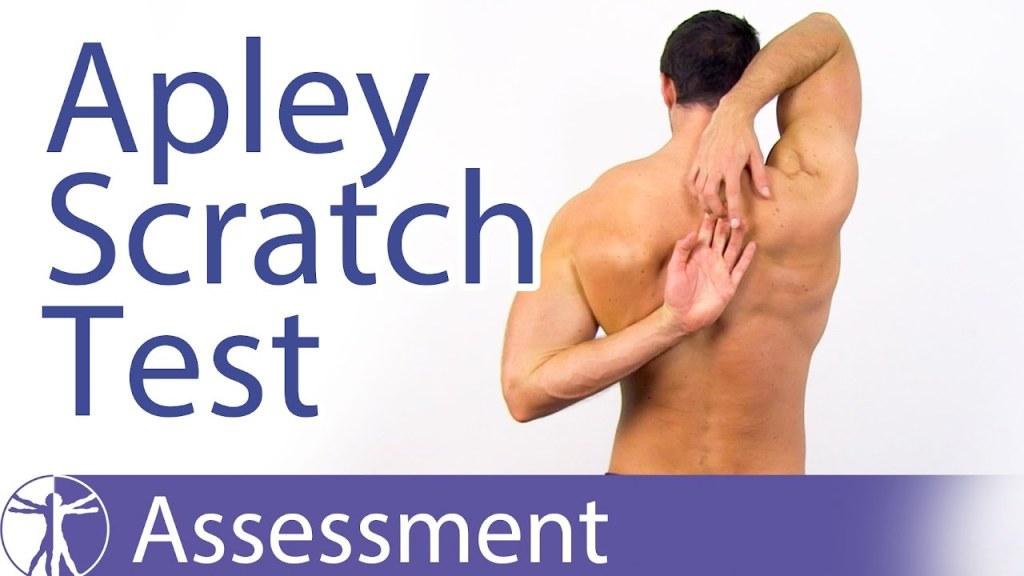
This is called the Apley Scratch Test. To perform it, stand tall and reach one arm up and over your shoulder to try and touch as low down the shoulder blade as you can. With the other arm, reach behind your back and try to touch your fingers as far up your back as possible. Ideally, you would be able to touch your longest fingers together. It is an acceptable result to at least be able to touch the top of your shoulder blade with your top hand and the bottom of your shoulder blade with your bottom hand.

The problem is, 93% of the population cannot do this. That is a big problem.

The problems become magnified as I said when you then go and perform some of the most popular lifts in the gym with this mobility deficit. Exercises like the bench press, lat pulldowns, bench dips, chest dips, and even barbell rows are all compromised when you don’t have adequate range of motion of the shoulder joint which is precluding you from achieving the touching of the fingers behind your back.

From a biomechanical standpoint, the top arm needs to have shoulder flexion and external rotation range of motion while the bottom arm needs to have shoulder extension and internal rotation mobility. Most will struggle to get the bottom hand sufficiently up the back. A loss of internal rotation is a common side effect of muscle imbalance and adaptive stress of the shoulder. 

Don’t worry if you don’t pass through. I’m going to show you three ways that you can improve this quickly.

  • The first is by concentrating on unshrugging your shoulders, whenever you do any of the exercises listed above. Instead of forcing your shoulder blades down and back, which can lead to an artificial pinching of the scapula together, just concentrate on keeping your shoulders down and unshrugged. This will take care of the shoulder blades and make it easier to keep the joint stable, preventing them from tipping forward into a dysfunctional anterior tilt.
  • The second thing you can do is include a sleeper stretch into your mobility routine. This will help to eliminate glenohumeral internal rotation deficit or GIRD. The key is making sure to keep the head of the humerus down to accurately assess the loss of range into internal rotation and to keep the stretch where it needs to be. Letting your shoulder pop up is only going to trick you into thinking you have more motion than you do and won’t help you to fix this problem long term.
  • The third thing you want to do is use either a band or a doorknob to perform the test as a corrective exercise. Either hang the band over the pull-up bar and reach behind your back to grab it or stand in front of a door and reach behind you to grab the knob. In either case, from here you want to squat or alter your body in space to deepen the stretch on the shoulders and let the arm rise higher behind the back.

The Bottom Line

Try these out and I promise you that even if you can’t touch your fingers behind your back right now, you will be able to in no time. For more posts like 8 min Abs workout at home and much more, be sure to subscribe to our blog at the link and turn on your notifications so you never miss a new post when it’s published.

Advertisement

https://pagead2.googlesyndication.com/pagead/js/adsbygoogle.js


Do This EVERY DAY for a Flat Lower Belly (GUARANTEED!)

What’s up guys, today I’m gonna show you something that you can do every day (best in the morning) that is going to GUARANTEE to help you to flatten your lower belly. 

If you want to flatten your lower belly you have to do more than just diet. In this post, I’m going to show you how even if you create a caloric deficit you still might have a protruding lower abdomen because the muscles in this area, particularly the transverse abdominis, are not as toned and developed as they should be. This is something that can be addressed however with something as simple as one move that can be done first thing in the morning for less than a minute. The exercise is called the stomach vacuum. This is an abdominal exercise you may associate with old-time bodybuilders, but there is more value to it than preparing you to step on a stage you likely never had any desire to in the first place.

The role of the transverse abdominis muscle is to act as your internal weight belt. When contracted, it will shorten, and in doing so, cinch down on the lower abdomen and tighten up your waist. The key to getting this right however is not simply to suck in your belly. That is not going to contract this muscle as it needs to be.

Remember, the orientation of a muscle’s fibers will always tell you the preferred function of the muscle. Here, the fibers run east to west around your waist. When toned, this muscle will sit naturally tighter (ie. shorter) than it will when untrained and de-conditioned. Just like the upper back muscles will often lead to forwarding rounded shoulders and a slumped posture when they are not trained or strengthened, the same thing happens here.

That said, the fix is quick and easy and will not take much-added effort on your part. The only thing you may have to do is practice the movement just a little bit to get a better feel of how to contract the muscle. So here is how you want to do it.

  • First, it may be easiest to practice this by leaning onto something like the edge of a bed or table since engaging the transverse abdominis is going to be more immediate from this position than it will be in standing.
  • Lean forward onto your elbows and take a big deep breath in.
  •  From here, slowly expel all of the air out of your lungs, I mean every last bit that you can consciously get rid of.
  • At that moment, instead of breathing in, try to pull your belly button back to touch your spine. If you did this right, you will find that it is fairly easy to do this because of the vacuum or negative pressure you have created up to this point in your abdomen. 
  • Pull the belly button back and keep the contraction held for as long as you can.

In the beginning, you are going to find that you will not want to take a breath during the process since you will likely lose the ability to keep the contraction. As you get better at it, however, you will not only be able to hold your breath for longer but you will be able to take small breaths without sacrificing the quality of the contraction. Work up to three 20 second holds but start with 4-5 repetitions of shorter duration holds. 

The Bottom Line

“The key is not holding for many many repetitions but rather the consistency of doing this every day that will have the biggest benefits for you to achieve a smaller flatter abdomen”. Of course, if you want to get rid of the body fat overlying this area then you are going to need a good meal plan to follow as well.

For more posts like 8 min Abs workout at home and much more, be sure to subscribe to our channel at the link below and turn on your notifications so you never miss a new post when it’s published.

Instagram Link Below:

Something went wrong. Please refresh the page and/or try again.

https://pagead2.googlesyndication.com/pagead/js/adsbygoogle.js

Design a site like this with WordPress.com
Get started